Today’s society is developing in the material sphere. The pace of life is changing rapidly.
There is also increasing use of natural resources, yet population balance and control are not being achieved.
According to economic principles, when the standard of living is low, the population grows. India is perhaps a victim of this very poverty.
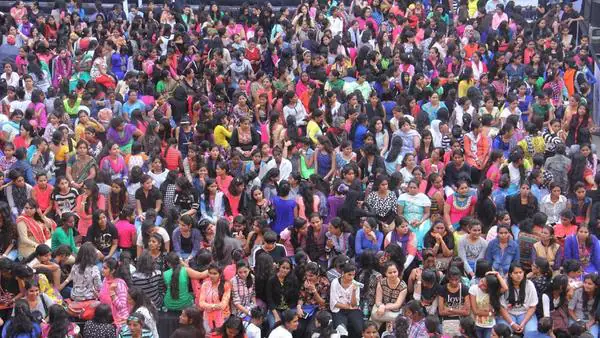
The problem of population growth gives rise to many other problems. Every year, the food produced becomes insufficient, and what is available becomes expensive. Similarly, the prices of other essential goods also rise. The government faces a shortage of jobs, so unemployment keeps increasing.
Due to scientific progress, capitalist or imperialist dominance increasingly neglects human labor. In such a situation, stabilizing the population has become an essential demand of our times.
The renowned thinker Garner has said that a state’s population should never exceed the resources it possesses. In other words, it can be said that population is a boon for any country, but when it crosses the maximum limit, it turns into a curse.
At present, India ranks first in the world in terms of population. We are facing the problem of a population explosion.
The scale of this growing population can be estimated from the fact that at the time of independence, India’s population was only 330 million (33 crore), which has now grown to approximately 1.46 billion (146 crore). About 18% of the world’s population lives in India, while India’s land area is only about 2.5% of the world’s total land area. This is extremely worrying for us.
A few years ago, the United Nations published a report on global population which stated that by 2027, India’s population will cross 1.5 billion. Currently, India’s population is 1.46 billion. According to the report, the entire world’s population, which is now 8.10 billion, will rise to over 10 billion in the next three decades—that is, by 2050.
This UN report notes that between 2010 and 2019, India’s population grew at an annual rate of 1.2%, while China’s growth rate during the same period was only 0.5%. In India, a woman gives birth to an average of 2.3 children. Though this birth rate has improved significantly over the past five decades (in 1969 it was 5.6). Globally, this figure is currently about 2.5.
If we look at life expectancy, in 2019 it was 69 years, whereas in 1969 it was just 47 years. Currently, Japan has the highest average life expectancy in the world at 84 years. According to the UN report, more than half of the world’s population growth will occur in just nine countries: India, Nigeria, Pakistan, the Democratic Republic of Congo, Ethiopia, Tanzania, Indonesia, Egypt, and the United States.
Compared to all other countries, India will face the most severe form of the population growth problem. The report states that India’s population will continue to grow for many years to come. There’s no doubt that rising population is creating new challenges in many ways. Incomplete family planning programs, illiteracy, lack of health awareness, superstitions, and developmental imbalances have all contributed to rapid population growth.
Now that India has become the most populous country in the world, the population challenges it faces will appear in an even more serious form.
If we want to save the country from a population explosion, we will need to design plans that can make ordinary people economically prosperous. We must also work on improving literacy so that the light of education reaches everyone. Public participation in family welfare programs must be ensured. Policies must be created in such a way that people are motivated to take an interest in them on their own.
The population control efforts during the Emergency period are well-known to everyone. At that time, there was tremendous public anger against the government’s attempts, and the government paid a heavy political price for it.
It is clear that if there remains a disconnect and imbalance between population control policies and public perceptions, good results will not follow. It is unfortunate that over the last seventy years, the government and various social organizations have failed to establish meaningful dialogue with the public to find a permanent solution to this problem.
The main concern is to stabilize the population. Undoubtedly, stopping population growth in India is a difficult challenge, but it is not an impossible one. If the country wants to avoid yearly increases in population, there is only one path left: people must be made to swallow the bitter pill of necessary family planning and discouraging population growth. For this, an appropriate population policy is also required.